
It seems that every Tom, Dick & Harry on Folksy and Etsy are obsessed with light boxes at the moment. I thought I should investigate further, as like many sellers my product photos could do with a little ooomph. I thought about buying a ready made kit but in the end I'm such a cheapskate that I decided to make one myself. I used
this tutorial as the basic guide which was very helpful and quick to do.
I bought the poster foam board stuff from an art shop for around £1 per sheet and a local light shop was having a closing down sale so I got some very cheap light fittings and daylight bulbs. The first bulbs I used were fine, but after one or two attempts I decided to try energy saving daylight bulbs instead. They are the equivalent of a 75 watt normal bulb and they give a much brighter intense light.
The box is stuck together with masking tape and can be disassembled easily enough between uses. I'm still experimenting with different backgrounds at the moment. I bought some royal blue card as a back drop and while it works well with some of the things I've photographed, I think it's a bit too dark with my cards. Trouble is, since my cards are mostly white or cream they don't stand out too well against the white of the poster board. I'm thinking of using a lighter blue, but I'm still experimenting at the moment. So don't all rush off to look at my product photos, as I haven't changed them yet!

Here's a photo I took of a pot of Colonel Ichabod Conk's Moustache Wax (don't ask!)
It hasn't been manipulated in Photoshop at all as I thought it I'd show how it turned out without any editing. Not too bad, I think. I set the white balance on my camera to Daylight and used the macro setting. The camera I used for this was a pretty basic Sony Cyber-shot.
Finally, I thought I'd show you a photo of the light box itself. You can see that in this photo I'm only using 3 lights, but usually I'd have 4 at least. It's a bit difficult to get a decent photo of it, but I'm sure you can get the gist. I don't have a tripod for my camera so I rest my sha
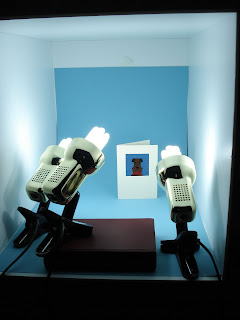
ky hands on a
couple of books to steady the shot. I don't usually have the lights in this position either, but it was tricky trying to fit everything in. The box itself is balanced precariously on my cooker hob!
As you can see, my photography skills are limited, but I thought it might be useful to show how an amateur can improve macro shots and I hope at least some of you find it helpful.

 Last week I spend an enjoyable day with Mike, Treasurer of the British Printing Society and his two cats. He is my letterpress mentor and very kindly offered to teach me the rudiments of typesetting, using one of his Adana 8x5 printers.


